
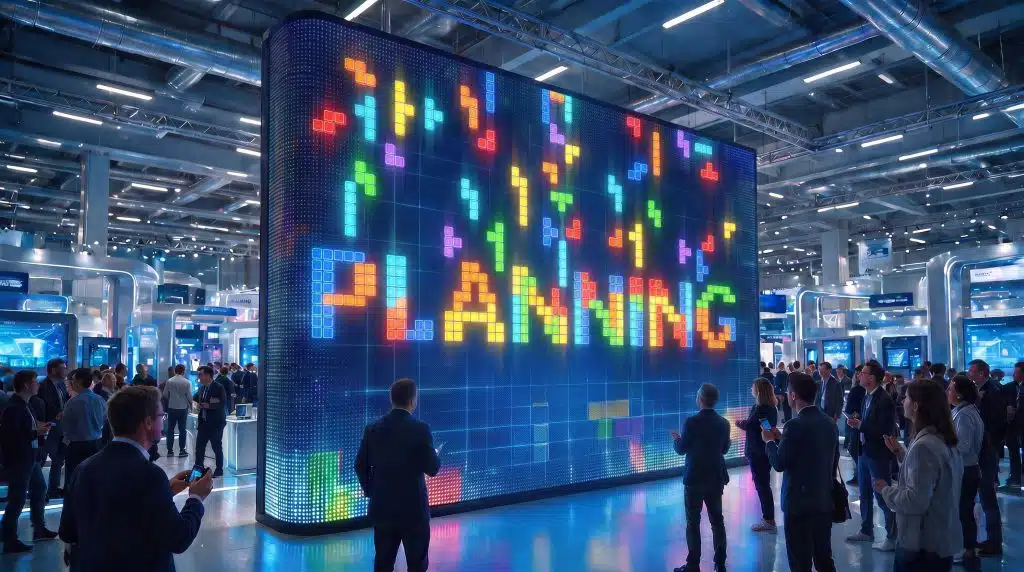
In many trade show projects, the screen is one of the first decisions. But a strong trade show content strategy should come first.
What size should it be?
Where will it be placed?
Should it be an LED wall, a corner screen, a flexible LED screen, or a touchscreen?
What resolution is needed?
How large should the display feel inside the booth?
These are important questions. But one question often comes too late.
What is the screen supposed to do?
Not technically. Strategically.
Is it there to attract attention?
Create atmosphere?
Present a product?
Support the sales team?
Invite interaction?
Make the booth more memorable?
A screen can be impressive on its own. But without the right content strategy, it can easily become just another display.
The content is what gives the screen its role.
Pixel Pitch Is Not Only a Technical Detail
Pixel pitch describes the distance between the pixels on an LED screen.
In simple terms, the smaller the pixel pitch, the sharper the image can appear from a closer distance.
For trade shows, this matters because visitors may view the screen from different distances.
Some will see it from across the aisle.
Some will stand close to it.
Some will pass by quickly.
Some will stop and watch.
This affects the type of content that should be created.
A screen viewed from far away needs strong movement, clear shapes, and simple messaging.
A screen viewed from close range can support more detail, but it still needs to remain clean, readable, and visually focused.
The technical specification affects the creative decision.
And the creative decision should influence the technical choice.
Viewing Distance Changes the Content
Trade show screen content is not the same as a website video.
A website video is usually watched from a fixed position, on a smaller screen, by someone who chose to press play.
A trade show screen is different.
Visitors are moving. They are scanning the space. They are comparing booths. They may only give the screen a few seconds before deciding whether to stop or continue walking.
That means the content needs to be designed for recognition.
It should be clear from a distance.
It should have strong visual rhythm.
It should avoid unnecessary detail.
It should communicate quickly.
It should support the booth, not compete with it.
This is one of the reasons a standard corporate video often does not work well on a booth screen.
The environment is different, so the content has to be different.
The Screen Should Fit the Booth Story
Screens today are no longer limited to a flat rectangle on a wall.
A booth can use a wide LED wall, a vertical screen, a corner screen, a flexible LED surface, a transparent display, a touchscreen, or a custom screen setup.
But each of these formats creates a different kind of opportunity.
A wide LED wall can set the atmosphere of the entire booth.
A corner screen can create depth and movement.
A flexible LED screen can follow the shape of the booth.
A touchscreen can let visitors explore information.
A screen behind a physical product can frame it and make it feel more important.
The format should not be chosen separately from the story.
If the screen is part of the booth architecture, the content should be planned as part of the architecture too.
That is how the screen begins to feel integrated, not added.
From Display to Interaction
Not every booth needs interactive content.
Sometimes a strong visual loop on a large screen is the right solution. Sometimes a product animation is enough. Sometimes a screen that supports a physical display can create exactly the right moment.
But when the goal is to let visitors explore, choose, compare, understand, or take part in the experience, interactive content can add another layer.
At that point, the screen is no longer only showing information.
It becomes a tool for engagement.
Interactive Content Needs Earlier Planning
Interactive content is different from passive screen content because it responds to the visitor.
Touchscreens, kiosks, product selectors, AR, VR, interactive demos, quizzes, simulations, and motion based experiences all require a clearer plan before production begins.
The questions become broader.
What can the visitor choose?
What path can they take?
What information should they discover first?
What happens when the booth team is busy?
Should the experience collect leads?
Can the content be updated later?
How does the sales team continue the conversation?
These are not only technical questions.
They are content, marketing, and sales questions.
That is why interactive booth content should be planned early in the process, together with the booth layout, screen setup, and visitor flow.
Real Booth Conditions Matter
Digital content for trade shows is created for a real environment.
That environment includes screen size, placement, height, lighting, viewing distance, visitor movement, playback system, and sometimes connections to touchscreens, kiosks, sensors, or other interactive tools.
This does not need to make the process complicated for the client.
Actually, it helps simplify it.
When these conditions are understood early, the content can be designed to fit the space more accurately. It can look better on the screen, connect more naturally to the booth, and support the message more clearly.
Breeze is not a hardware supplier or booth builder.
But our work is directly affected by the environment where the content will appear. That is why we prefer to understand the screen, booth, and viewing conditions from the beginning.
This helps make sure the content is not created separately from the booth.
It becomes part of the overall experience.
Every Screen Needs a Role
Not every screen in a booth should do the same thing.
A large screen at the entrance can attract attention.
A video wall can create atmosphere.
A touchscreen can allow exploration.
A smaller screen can support a sales conversation.
A screen behind a product can highlight it.
A social screen can show live updates or campaign content.
When every screen has a clear role, the booth feels more intentional.
When the roles are not defined, screens become places to put content.
The difference is strategy.
What to Define Before Production
Before producing content for a trade show screen, it helps to define a few things.
What is the goal of the screen?
Where is it located in the booth?
What distance will visitors see it from?
What is the screen size, ratio, resolution, and pixel map?
Is the screen passive or interactive?
How does it connect to the booth design?
What should the visitor notice first?
What should happen after they see it?
These decisions do not slow down the creative process.
They make it more accurate.
The Content Should Lead the Decisions
Choosing a screen is an important decision.
But it should happen together with content planning.
When the screen is selected first and the content comes later, the creative possibilities are often limited by decisions that were already made.
When the process starts with the question, “What do we want the visitor to experience?”, the screen, format, technology, and content can be chosen more intelligently.
Sometimes the right answer is a large video wall.
Sometimes it is a touchscreen.
Sometimes it is a product visualization.
Sometimes it is a corner screen.
Sometimes it is a combination of tools.
The goal is not to choose the biggest screen.
The goal is to choose the right screen for the right content.
The Bottom Line
Before choosing the screen, plan the content.
Not because content is more important than technology, but because technology becomes meaningful only when it serves a clear idea.
At a trade show, the screen is part of the booth.
But the content is what makes it communicate.
When screen, content, message, booth conditions, and visitor experience are planned together, the result can become clearer, stronger, and more memorable.
That is the difference between a screen that is placed inside the booth and a screen that works for the booth.
More From This Series
Part of the series: Your Booth Screens Can Do More Than You Think.
The New Role of Screens in Trade Show Booths
Before, During, and After the Show
Ready to Turn Your Trade Show Into a Full Campaign?
We help exhibitors plan visual content that works before, during, and after the show, not just for three days on the floor.