
It feels like this question comes up in almost every meeting today: “How can we use AI to create more visual content — faster and at a lower cost?”
The pressure to move faster is understandable. But in many cases, the rush toward AI shortcuts creates the opposite result: wasted time, unnecessary costs, and visuals that don’t fully support the brand.
The challenge today is not whether to use AI. It’s understanding where it actually works.
So we built a simple framework to help make that decision clearer.
May 23, 2026 · 5 min read · By Breeze Animation
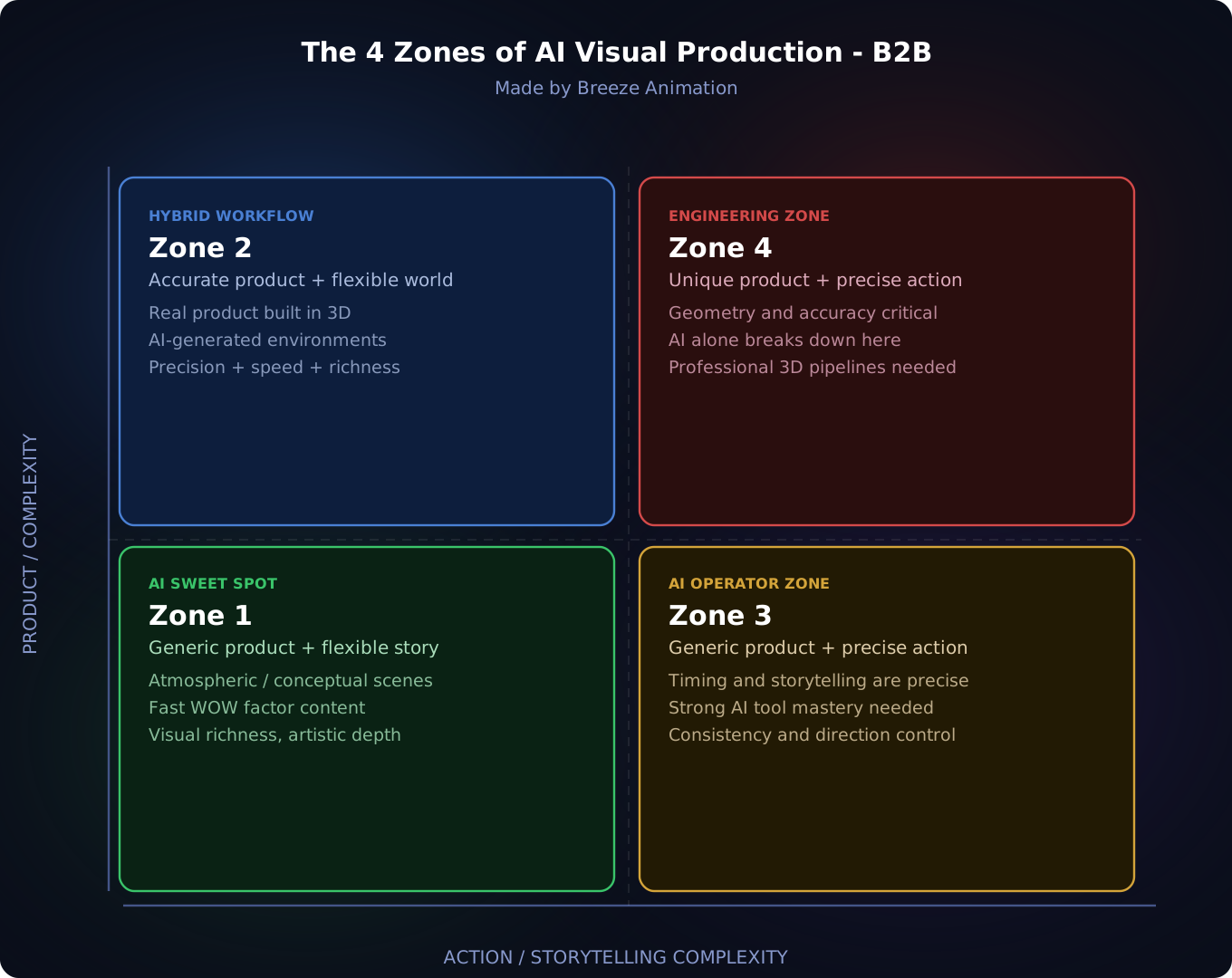
This is where AI performs at its best.
Typical characteristics:
Generic-looking products · Atmospheric or conceptual scenes · Flexible storytelling · No strict technical accuracy required
This is where AI can generate visually rich imagery, artistic complexity, and fast “WOW factor” content.
Recommendation: Go for it. This is the most efficient place to save time and budget while still creating strong visual impact.
Here, the product itself must be accurate and realistic, but the surrounding world can remain flexible. This is where hybrid workflows become extremely powerful.
Typical workflow:
Build the product accurately in 3D · Combine it with AI-generated environments, lighting, or atmospheres
This creates a balance between precision, flexibility, speed, and visual richness.
Recommendation: One of the strongest approaches available today — but it requires experience in both 3D production and AI workflows. Not something we recommend approaching casually.
In this scenario, the product itself is relatively generic — but the action, timing, or storytelling must be precise.
The challenge here is not realism. It’s control. You may not need structured 3D workflows, but you do need strong technical understanding of AI tools to maintain consistency and direction.
Recommendation: Possible to achieve great results — but only with hands-on experience and careful workflow management.
This is where things become difficult.
Typical characteristics:
Unique or engineered products · Highly specific actions or demonstrations · Precision is critical
This is where AI alone usually breaks down. The more technical the product becomes, the harder it is to maintain geometry, consistency, accuracy, and realism.
Recommendation: Don’t try to brute-force AI into solving this alone. This is where professional 3D and animation pipelines still matter most.
AI is not a magic solution. It’s a powerful production tool. When used correctly, it can save enormous amounts of time and resources. When used incorrectly, it can waste both — while creating visuals that ultimately don’t serve the product or the brand.
The real advantage today isn’t simply “using AI.” It’s understanding where AI adds value, where it introduces risk, and where precision matters more than speed.
That’s the difference between a smart workflow and an expensive experiment.
The future of visual production is not AI vs. traditional production. It’s knowing how to combine the right tools for the right type of project. Because not every project belongs in the same zone.
If you’re planning visual content for a product launch, campaign, or trade show — it’s worth understanding which workflow actually fits your project before jumping into production.
Quick answers about AI production zones and how to use this framework.
Not always. AI works best for Zone 1 projects — generic, atmospheric visuals where precision is not critical. For engineered or complex products (Zone 4), AI alone produces inaccurate results. The right zone depends on your product type and the accuracy your audience expects.
Zone 2 (Hybrid) combines an accurate 3D product with AI-generated environments. Zone 3 (Operator) is where a skilled human directs AI tools carefully, reviewing and correcting every output. Zone 2 is about combining workflows; Zone 3 is about human-directed AI with full control.
Ask two questions: How complex is the product geometry? And how critical is accuracy? Simple + low accuracy = Zone 1. Complex + high accuracy = Zone 4. Everything in between is Zone 2 or 3 depending on timeline and budget. Not sure? We are happy to help you map it.
We help B2B marketing teams build visual production strategies that actually work, using the right tools in the right places.